Showing posts with label Hospitality Congeniality. Show all posts

Saturday, June 25, 2011

touring with a group


      If you've ever toured with a group, you know the pluses and minuses of traveling together, many of which relate to hospitality. 


I'm very, very tempted to rant about several hospitality fatalities encountered during my experiences touring with other travelers. But in the spirit of good relations, I'll veer toward prescriptions.  

1. Be grateful.  When someone buys you a drink, a meal, or a gift, say "thank you" with more than a hint of sincerity.  You are not entitled to anyone being gracious to you.

2.  Be gracious to others.  Regardless of how others respond, continue to extend your generosity, hospitality, and good manners.  Hold the door, offer to pay more than your share, and help with sticky situations.

3.  Be a good roommate.  At the very least accommodate your roommate's reasonable wishes.  If she's hot, allow her to turn up the AC.  If he likes to sleep on one side of the bed, give it to him.  Go beyond accommodating and anticipate your roommate's needs.  What would it be like to use the restroom after you?  Have you created a problem for the next person using something in your hotel room?  Will your roommate need some time alone?  Does your roommate like to separate during the day?

4.  Be sociable.  Start conversations.  Ask others questions about their lives. Listen to what others say.  Being shy is not an excuse for being unsociable.  Give others a turn to speak.  Joke only about yourself.  Praise others.  Spend time with a variety of people traveling on the trip.

5. Be independent.  Have a map of the city. Know where you're going and how you're getting there.  Know the name and location of your hotel and bus.  Have emergency contact information with you at all times. Become familiar with how to use your phone or a public one if you’re overseas. Help out others if they're disoriented.  

6. Learn and use the language.  Greet people, excuse yourself, thank others, and ask questions in the native language.  Don't worry about your pronunciation.  Just give it a shot.

7.  Research the history and culture of the places you're visiting.  Acquaint yourself with the government, economy, art, history, customs, hospitality, and religions of your host land.  Familiarize yourself with your itinerary and be eager to hear more information.

Following these few steps toward being a hospitable group traveler will enhance your host-guest skills and very possibly, your own traveling experience.

Monday, February 15, 2010

Readiness, Risk, and Hospitality Morality lessons from Amy G. Oden (Hospitality Congeniality)

In her book, And You Welcomed Me: A Sourcebook on Hospitality in Early Christianity, Amy Oden expands our understanding of hospitality to ethical and spiritual realms. Much like the work of Emmanuel Lévinas and Martin Buber, Oden notes that acting humanely extends beyond offers of beverage, food, and entertainment. Respect is the precondition for such offerings. My mother used to say, “If you can’t do it out of love, don’t do it at all.” We are reminded of Martin Luther’s insistence that proper faith must ground all proper action or no value and goodness is achieved. To respect another involves, according to Oden, as well as Lévinas and Buber, a “recasting of social relations” in order to “reframe social relations and engender welcome” (14). Oden turns to the early Christians to guide us toward a moral awareness of and commitment to hospitality: “Early Christian voices tell us again and again that whether we are guest or host we must be ready, ready to welcome, ready to enter another’s world, ready to be vulnerable. This readiness is expectant. It may be akin to moral nerve. It exudes trust, not so much that one will succeed in some measurable way, but that participation in hospitality and its consequences. At the same time, the readiness that opens into hospitality also leads to repentance” (15). This readiness can be painful because it requires hosts to authentically reconsider initial perspectives of both guests and hosts themselves. Oden calls this a “de-centering of perspective,” which results in both parties discovering “something new, approaching the edge of the unfamiliar and crossing” (15). In such cases, hosts focus on their guests, not themselves.  Oden reflects, that although one may be entertaining at home, one longer feels “at home.” She cautions, “When we realize how we have inflated our own frame of reference and imposed it on all of reality, we know we have committed the sin of idolatry, of taking our own particular part and making it the whole.” Let’s stop here, leaving the early Christians behind for a moment, and personalize Oden’s premises.                                                     Google images:
                                                         http://www.onlineoriginals.com/showfile.asp?itemID=287&filetype=picture
                 
I am trying to recall if I have ever hosted a gathering in which I privileged my readiness for (or is toward) my guests over my perspective—or, more honestly, over my ego. In the spirit of Augustine’s Confessions (which I’m teaching this week), I’ll illustrate. Thinking back...I was probably more concerned about the wow factor of serving hot homemade eggrolls (who does that) than the annoyance factor of high oil odor permeating the house for several days. I was probably more concerned about the wow factor of serving a chicken liver terrine than the likelihood that university students would rather have cheese dip. I was definitely more concerned with the wow factor of concocting one complicated dish after the next than releasing myself from the kitchen to take care of my guests.
/Pictures/StandardBibleStoryReadersBook5/images/scan0014-1.jpg]
Shame on me for forgetting what the ancient Greeks knew: being a host extends beyond personal ego and even beyond personal virtue to the realm of the gods. We know that as wayfarers, the Greeks relied on Zeus’ protection when visiting and being visited. They never knew if the knock on the door signaled a “theoxenia,” a divine visitation (18). I teach the xenios code in my first semester classes. This code required Greek hosts to welcome strangers, offering them food, drink, shelter, entertainment, and ablutions—without any assurance that the stranger was important or able to reciprocate. So too, the Hebrews valued hospitality.  Oden recalls when Abraham welcomes strangers at Mamre, Rahab welcomes spies, and when Zarephath’s widow welcomes the prophet (17). The Romans also prized a moral sense of hospitality related to the gods.  Even Ovid’s Metamorphoses takes a break in its serial stories of the gods’ raping and rampaging to inspire readers with the Roman duty of hospitality with its Philemon and Baucis story. Beyond narrative, the Roman legislated hospitality with their “jus hospitii, or law of hospitality," which distinguished seven different hospitality relationships (18).

Adopting such a Greek, Hebrew, and Roman ethical stance toward hospitality, Oden warns that “[t]he success of hospitality, however, does not depend on end results. Rather, the success of hospitality is measured by the degree to which one offers one’s genuine presence with another, to fully enter another’s world and dwell with another” (109). We have returned full cycle.

So take a risk and nix your ego, all you fellow hosts. Embrace your guests, not just with a friendly Sedaris “I Like You” reception but with “zeal and full of life, with readiness” (Oden 117) Treat your guests like Philemon and Baucis did, offering more than what you can afford to give, not just of your resources but of yourself. Let go of preconceptions about your guests and yourself. Afford your guests the hospitality to feel “at home” but not yourself. You, as host, should be off balance—not sure of yourself, not attending to yourself, and ultimately, not aware of yourself. With readiness, embrace hospitality morality.                 [google images


Oden, Amy G., Ed. And You Welcomed Me: A Sourcebook on Hospitality in Early Christianity. Nashville: Abingdon Press, 2001.

Saturday, February 13, 2010

Personal Identity, Reciprocity, and Hospitality Morality Lessons from Tracy McNulty (Hospitality Congeniality)

   In The Hostess: Hospitality, Femininity, and the Expropriation of Identity, Tracy McNulty educates us that the word “hospitality” connotes both reciprocity* and “personal identity”** (ix). Doesn’t that present the essential dilemmas of hospitality? As a host, how can I be true to myself but authentically embrace true reciprocity in the spirit of Oden’s “readiness” (see Oden blog)? Beyond hospitality concerns, isn’t that the critical dilemma of literature, politics, education, relationships, and economics? That is, isn’t this hospitality dilemma between being an “I” and relating to a “you” the essential human struggle. McNulty agrees: “The problem of hospitality is coextensive with the development of Western civilization, occupying an essential place in virtually every religion and defining the most elementary of social relations: reciprocity, exogamy, potlatch, ‘brotherly love,’ nationhood. … “ (vii). Where once, hospitality was relegated to the decrees of the gods and hosts were forbidden to profit, today, hospitality is reduced to the “so-called hospitality industry (tourism) and a social and political discourse of parasitism, in which the stranger is construed as a hostile invader of the host nation or group” (viii). Has this exchange of divine order for economic exchange improved hospitality or has it, as McNulty insists, replaced authentic human interactions with “the irrational side of our relation to the stranger—fear, anxiety, and hatred—[which] seems to grow ever more virulent” (viii)?

Again, we are faced with ethic’s grasp on hospitality, which McNulty contends is even more controlling. All nostalgia for the “social harmony” of Philemon and Baucis aside, McNulty wonders, as does HospitalityMorality, if we realize that hospitality--as the most fundamental of ethical issues--can address and resolve the tensions “between unnamable alterity and legal identity, between infinite debt and economics, between ethics and ontology” (viii). This brings us back to our linguistic lesson of the double meaning of “hospitality.” First, although hospitality directs us out to another, it also calls us draws us in to our own self-estrangement. Often, this is uncomfortable—even, painful and frightening. McNulty explains why: “Hence it both allows for the constitution of identity and challenges it, by suggesting that the home can also become unhomely, unheimlich, estranged by the introduction of something foreign that threatens to contaminate or dissolve its identity” (vii).
http://records.viu.ca/~lanes/english/engl200/lear_cor.jpg

I take McNulty’s point. I know that feeling when, as a host, the stranger entering my home threatens to belittle or devalue who I am. Like the guest who called me a liar at dinner. Like the guest who racialized female attractiveness. Like the guest who spews homophobia. I’ll stop because you get my point, and I'm straying from good thoughts of hospitality. Suffice to say that on these occassions, I was more than uncomfortable. I felt threatened. McNulty exemplifies simlilar threats when she retreats to the myths of Western literature: Agamemnon, Gloucester, and King Lear--all threatened sovereigns.  All nobility aside, I return to my threatening guests who challenge me to withdrawn and repose into that “right reason” state that Marcus Aurelius exhorts—that mental place where I reexamine who I am and how I will treat others. So beyond these guests’ contaminations, the real threat is a hard look in the mirror at my own participation in such rudeness and prejudice. This takes care of one criteria for hospitality: identity.
http://ovationtv.com/files/large_image_videos/0000/0240/virginia_woolf_372x280.jpg
As for the other criteria—reciprocity—the dilemma that McNulty and HospitalityMorality see is how to “welcome the foreigner without denying his foreignness” (48). To accomplish this authenticity, the foreigner must feel at home and the host must feel displaces. HM addressed this very issue in its Oden blog. McNulty clarifies: "The ethics of hospitality…involves not only welcoming the familiar into the home, but calling the home into question: experiencing the dispossession of the chez soi, and through it the identity of the host” (xx). Think of that scene in Virginia Woolf's To the Lighthouse when Mrs. Ramsey is serving dinner and one of her guests upsets the timing of her boeuf en daube entrance onto the table by asking for a second helping of soup. Of course, to someone who hasn’t hosted a tricky-timed meal, his request seems trivial and her agitation seems ridiculous. HM can easily argue that neither is the case.  However, for this discussion, let’s grant those two positions--he's innocent and she's overreacting. What’s important to HM's investigations of hospitality morality is that Mrs. Ramsey abides his request—knowing that she risks ruining the entrée for all her guests.  Further, if you don’t think that she is no longer at home in her home (and for good reason), then HM suggests you squeamishly mistime the presentation of a piece of medium rare beef with a dozen critics at your table.

HM asks how, in such cases of demanding or demeaning guestshosts can establish harmony--not only between guest and host but also between reciprocity and identity.  If HM had that answer, its work would be concluded. At this point, all HM knows is that for such occasions, hosts and guests need etiquette rules, which serve as a kind of “potent symbolic structure to account for and valorize the risk the host assumes in welcoming a stranger” (52).  So for the time being, as HM wades through the morality of hospitality, it bows to etiquette guides.

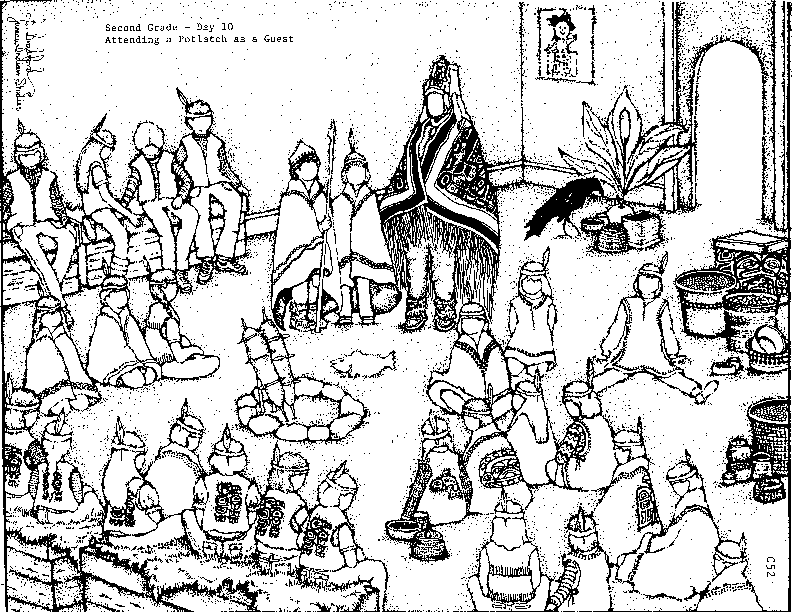
*I have put on my research list the potlatch practices of native North Americans, “a system of ever-escalating gifts and counter-gifts that binds parties together in mutual ties of obligation and is the very foundation of social and religious life” (x-xi). McNulty explains further that in the Native American “potlatch” tradition “the giver gains in social prestige what he loses in material goods. The more the master gives, the more he has: because his prestations will eventually be reciprocated by others, but more importantly because his prestige accrues in the act of giving” (xx). Definitely something worth researching.
http://www.ankn.uaf.edu/Curriculum/Tlingit/FishCamp/images/bigc-52.gif
**McNulty reminds us that the Roman notion of personhood, “persona,” meant mask, specifically, the mask displayed in the house of an ancestor (xxx).

McNulty, Tracy. The Hostess: Hospitality, Femininity, and the Expropriation of Identity. Minneapolis: University of Minnesota Press, 2007.

Tuesday, February 9, 2010

The Stoics Weigh in on Hospitality...Take a page from Marcus Aurelius' Meditations (Hospitality Congeniality)

  As common as it is frustrating, hosts often deal with rude guests and thereafter, beg sages (or advice columnists) for permission to, if not return the rudeness, at least to put said offensive guest in her place. Rereading Marcus Aurelius’ Meditations recently, I discovered a variety of advice, sometimes conflicting, for this hospitality dilemma.
First and foremost, returning rudeness is verboten as Aurelius warns, “[w]hatever any one does or says, I must be good, just as if the gold, or the emerald, or the purple were always saying this, Whatever any one does or says, I must be emerald and keep my color” (63).  Let's not get sidetracked with his color wheel illustration: be good because it's true to your nature (everyone's nature, he believes).  Additionally, Aurelius requires us to find the good in others, that is, he contends, the god in everyone. On the surface, then, it appears that hosts are Stoically stuck suffering insults. However, being good, even for this Roman General affords us some wiggle room.

Before we proceed with how Stoic hosts can either improve or tolerate rude guests, we must first examine the possibility that the offense is justified. On the heals of the offense, Stoics require us to stop and consider if the guest’s advice or criticism is warranted. A bit of soul searching is in order. Are you avoiding that guest who bores you? Did you ignored known dietary restrictions? Are you stealing the spotlight? Have you privileged your gourmet meals over your guests’ enjoyment? Are you a nervous wreck and hiding out in the kitchen? Aurelius guides us: “Judge every word and deed which are according to nature to be fit for the; and be not diverted by the blame which follows from any people, nor by their words, but if a thing is good to be done or said, do not consider it unworthy of thee” (40). Is it not impressive that a Roman emperor and general chides himself during his morning meditation that “[i]f any man is able to convince me and show me that I do not think or act right, I will gladly change; for I seek the truth by which no man was ever injured. But he is injured who abides in his error and ignorance” (54). Therefore, if accused, stop, reflect, and if you determine that the injury or criticism is warranted, then, correct yourself. Never mind the intentions of the criticizer.

Of course, there is that chance that you are not wrong, that you are an ever vigilant host. In those cases, the Stoics have more advice, advice that I think you'll like.  In search of it, we investigate Meditations further…”To be vexed at anything which happens is a separation of ourselves from nature…” In essence, being irritated (as mucha as irritating) destroys our sense of harmony with the natural order, our peace. How exactly, though, should we avoid being irritated by the guest who, for example, arrives late with an uninvited companion and proceeds to monopolize the dinner conversation while criticizing your menu selection and recipe executions? For Aurelius, who may at first seem extraordinarily tolerant, it’s really a matter of developing a sense of superiority. I imagine that you're attracted to that host-guest positioning because after all, you are  the one who did all the work.  Savor this bit of his Stoicism: “When a man has done thee any wrong, immediately consider with what opinion about good or evil he has done wrong” (65). If I understand him correctly, when injured, evaluate the ethics of the injurer. Maybe I'm confused.  Thankfully, Aurelius is clearer when he writes, “When another blames thee or hates thee, or when men say about thee anything injurious, approach their poor soul, penetrate within, and see what kind of men they are” (89). I think he's saying that if they’re good men, examine their offense; but if they’re not, don’t waste your time and energy. My favorite Aurelius advice pointedly addresses this point: “I have often wondered how it is that every man loves himself more than all the rest of men, but yet sets less value on his own opinion of himself than on the opinion of others” (116). Aurelius challenges those of us who think we’re special (meaning, most Americans) to question why we relinquish our self-confidence in the face of any criticism. Think about it: how many guests’ insults could we dismiss by determining them to be schmucks?  More delicately, Aurelius asks the injured to determine if the injurer has redemption possibilities: ” “If thou are able, correct by teaching those who do wrong…” (87). If not redeemable, this Roman general won’t spend any time trying to educate the uneducatable although he acknowledges our social nature: “Men exist for the sake of one another. Teach them then or bear with them” (83) for “indulgence is given to thee for this purpose” (87). For Aurelius, if you’re dealing with the etiquette- ignorant guest, don’t waste your breath, just let it go.

So the guest-offender aside, how do you, as hospitable host, “let it go”? The quick Stoic answer is a question: what would you gain from being annoyed? “Do not waste the remainder of thy life in thought about others, when thou dost not refer thy thoughts to some object of common utility” (23). Is there some point, some use to your frustration? Probably not. Or think of it this way: if you retaliate you’ve just let someone else’s lack of character determine yours. Afterall, “[h]e who does wrong does wrong against himself. He who acts unjustly acts unjustly to himself, because he makes himself bad” (83). Rather, say to yourself, “…it is in my power to let no badness be in this soul, nor desire, nor any perturbation at all…” (77). Practice that line many times so that when you’re fuming in the kitchen after your dinner guest starts meal texting. Well, if that advice doesn’t resonate with you, rest assured that you can acheiv a rested mind, a tranquil mind, one devoid of frustration and bitterness.  All it takes is a “good ordering of the mind” (29). Probably Hamlet said it better but Aurelius still says it well: evil in general (and offense in particular) are only and always mental constructs. “Take away thy opinion, and then there is taken away the complaint, ‘I have been harmed.’…and the harm is taken away” (31). Easier said than done, you might be thinking. It’s admirable but impractical as it’s a bit too optimistic for human nature, you might conclude. To you, Aurelius has two words: “Right reason.” Get your mind in order: “When thou hast been compelled by circumstances to be disturbed in a manner, quickly return to thyself and to do not continue out of tune longer than the compulsion lasts; for thou wilt have more mastery over the harmony by continually recurring to it” (51). It’s not surprising that this Roman emperor daily cautions himself to rise above petty complaints: “It is in thy power to live free from all compulsion in the greatest tranquility of mind, even if all the world cry out against thee as much as they choose, and even if wild beasts tear in pieces the members of this kneaded matter which has grown around thee” (71). Wild beasts at your table should and can be dismissed—although if not from your table, at least from your mind. So the next time a guest acts inhospitably, retreat and repose.
Think Stoic thoughts that instruct you how to react properly, guaranteeing not only the welfare of your guests (including the offender) but also your own happiness. In short, master your mind in order to control your sense of contentment.

But for Stoics, it goes beyond intention. One must act properly. And for late Roman Stoics, that means duty. “I do my duty: other things trouble me not; for they are either things without life, or things without reason, or things that have rambled and know not the way” (54). Your duty as a host is to act hospitably, plain and simple.

Aurelius, Marcus. Trans. George Long. Meditations. Buffalo: Great Books in Philosophy, 1991.

[I had a great flow chart developed for this post but can't figure out how to load it. Any help would be much appreciated!]

Friday, January 29, 2010

Hospitality Defined: Move over Amy Sedaris (Hospitality Congeniality)


  In  her book, I Like You: Hospitality Under the Influence, Amy Sedaris begins with a welcoming opening letter to “[your name here].” The tone is personal and friendly as is the message. Unfortunately, Amy, I couldn’t disagree more with your philosophy of hospitality. Let’s take this one sentence at a time.*
#1: “Whether you live in a basement with the income of a ten-year-old girl or on a saffron farm in the south of Spain, the spirit of hospitality is the same.”  First, in what fantasy world does economics not impact hospitality?  While expensive caviar doesn't guarantee hospitality, stone soup kills hospitality every time.  Second, how exactly is the “spirit” of hospitality common no matter the culture? My travels have indicated the opposite. While the spirit of Irish hospitality is friendliness, the spirit of Turkish hospitality is curiosity. While the hospitality spirit in Germany is generosity, in England it’s wittiness. In fact, that’s one of the difficulties of travelling—trying to discern the national or regional spirit of hospitality. For example, you’re wasting your time smiling at the Germans in Dusseldorf. Better to accept the room upgrade with seriousness politeness. That example illustrates that the “spirit” of hospitality is often linked to the “face,” of hospitality, which changes even within countries. Travel to any Mediterranean country and you’ll likely experience a different face of hospitality along the coasts than deeper in the mainland. If you don’t believe me, compare your experiences in Venice with Rome (which is considered a Mediterranean city by most travel agencies).
#2: “It’s the giving of yourself, a present of you to them from me for us.” Expecting hospitality to be personal misses the beauty and practicality of hospitality. It’s not personal. It’s a cultural code. Why is that so important to grasp? Because cultural codes, like myths, are the great levelers of all things unequal—one’s economics, religion, gender, age, personality, appearance, etc. When my German host constantly scans the table to see if glasses aren’t empty and no one is excluded from the conversation, it likely has nothing to do with his feelings for me personally. Don’t fret. That’s reassuring. For no matter that I'm a miscreant ringing the doorbell, the code welcomes me and guides me toward collegial behavior crossing the threshold. And no matter what Byronic hero I'm stuck inviting, I must defer to hospitality codes.  Whereas if you're relying on my false friendliness, I'm likely to slip up, sneering, "Get over yourself."  If you're not convinced that in every case, hospitality triumphs over friendship, I have one word for you--"family." When we are hospitable to our family, it’s because the family hospitality code dictates our actions. It’s certainly not because we’re going to end the evening holding hands and singing “Kumbaya.”
#3-#4: ‘Hello, and I like you.’ This is what you’re saying when you invite somebody into your home, without having to hear yourself say it out loud.” Again, it’s not personal. I don’t have to like you when I treat you hospitably. Frankly, most of the time, I don’t. That’s why I’m inviting you, [your name here], to think of hospitality not as friendliness but according to the second Merriam-Webster definition of “congeniality”: “existing or associated together harmoniously.” As someone once said, "“Hospitality is making your guests feel at home, even though you wish they were.” Of course, this brings to mind Kant’s categorical imperative and subsequent maxims. For Kant, as you well know, laws (codes) must be applicable to and enforceable by all. (Feel free to write me if you're eager to talk Kant more extensively. But for now, I should probably stay on track.) My point is that hospitality codes through the ages have existed so that different and even unfriendly people can co-exist in relative peace whereas relying on friendship has often led to anomie. If you don't believe me, read Arthurian legends.
I am embarking on a research project that will help us understand variations of hospitality codes—from the ancient world to the postmodern world and from the East to the West. Until then, I’ve begun with Amy and I promise to give her outlook a fair chance.
So to recap…think of hospitality more like congeniality than geniality. Or to put it more concretely...Your partner announces a dinner invite from his homophobic boss. When you arrive, do you really want to rely on your host immediately liking you? Or wouldn’t you feel more secure if your host just kept it impersonally hospitable? Hospitality Morality may not like you, but it promises its guests that for every feast, it will keep the peace.
*The more you read Sedaris's book, the more you suspect, then, realize that it's tongue-in-cheek.  However, you wouldn't realize that when you're reading the opening letters to her narratees.  I say, she wrote it and it's fair game for the serious critical review that Hospitality Morality always promises to deliver.
Special thanks to EatsMeatsWest.blogspot.com for the Amy Sedaris book recommendation.
Sedaris, Amy.  I Like You: Hospitailty Under the Influence.  New York: Warner Books, 2006.


Saturday, September 12, 2009

tribute to Theresa Pirron: 1905-2009 (Hospitality Congeniality)

Theresa Pirron, 104, of Northbrook, July 14, 2009. Beloved wife of the late Karl; Loving mother of Pauline "Polly" (Andrew) Jerch; Proud grandmother of Rick (Janie) and Don (Janet) Jerch; Fond "Oma" of Susan (Andy) Shuckra, Kirsten Jerch, Megan (Ned)Irons, Cory, Michael and Rhiannon Jerch. Memorial Mass Saturday, August 1, 2009 at 10 am at St. Norbert Church , 1809 Walters Ave. Northbrook. Interment St. Joseph Cemetery. In lieu of flowers memorials may be made to The Northfield Food Pantry, 3801 W. Lake Ave. Glenview, IL 60026 or please perform a random act of kindness for someone. posted on the N. H. Scott & Hanekamp funeral home's website.

After living a long and sanguine* life, Theresa Pirron left us on July 14, 2009. She was 104 years old. Many of her family remember her as a hostess and cook. To this day, I attribute my obsession with doling out leftovers for take-home meals to Oma who always offered Janie and me care packages. If I, as a young wife, wasn't always grateful, I should have been. There were other lessons I learned from her. With each meal, Oma had a knack for salvaging "discarded" food, which would soon contribute to another tasty meal. Oma illustrated how satisfying it is to cook for your family but also, how much work is involved. No fancy kitchen. No convenient appliances. Just patience, attention to details, and culinary basics. I remember her painstaking apple strudel, her slow-roasted pork roast, her savory liver dumplings, and many assorted other German dishes. I remember well her fried chicken. No matter how far South you journey, you just can't beat hers. I know that her family misses her. I miss her too. I can still picture her in her apron, smiling shyly, perspiring a bit, and sighing, "It's always something." Oma’s Fried Chicken…cooked by Theresa Pirron, told to and recorded by her grandson Don on 5/26/86 Preheat oven to 350. 1. liver—Defat chicken. Fry to get grease drippings. Fry onions, then livers. Brown each side approx. 5 mins.—not too much. 2. soup—Debone chicken. + neck; -back; +wing tips. Place in pan & simmer approx. 1-2 hours with onion, celery, and carrots. Strain broth. Save vegetables with broth. 3. fried chicken—Wash and separate [chicken pieces]. ____ fat piec? for ____liver fry _____.** Salt & pepper. Add 3 large scoops of Crisco to a large fry pan. Heat until it sizzles, using leg to test. Dredge pieces in flour, then dunk in egg + water, and then coat in bread crumbs. Fry until golden brown. Lay into baking dish or pan. To the pan, add 2-3 tbls “frying grease” + ¼ cup water. Season each piece with poultry seasoning and paprika. Cover chicken with lid or foil. Bake at 325 approx. 1 hr. **This is as accurate as I could get due to the paper being so faded and the assorted holes I’d punched in it for various notebooks over the years. Family members, if you have corrections, please let me know. *Sanguine: Cheerfully optimistic or confident; Having a healthy reddish color; Blood-red. [from Wordsmith]
"One cannot think well, love well, sleep well, if one has not dined well." - from A Room of One's Own by Virginia Woolf